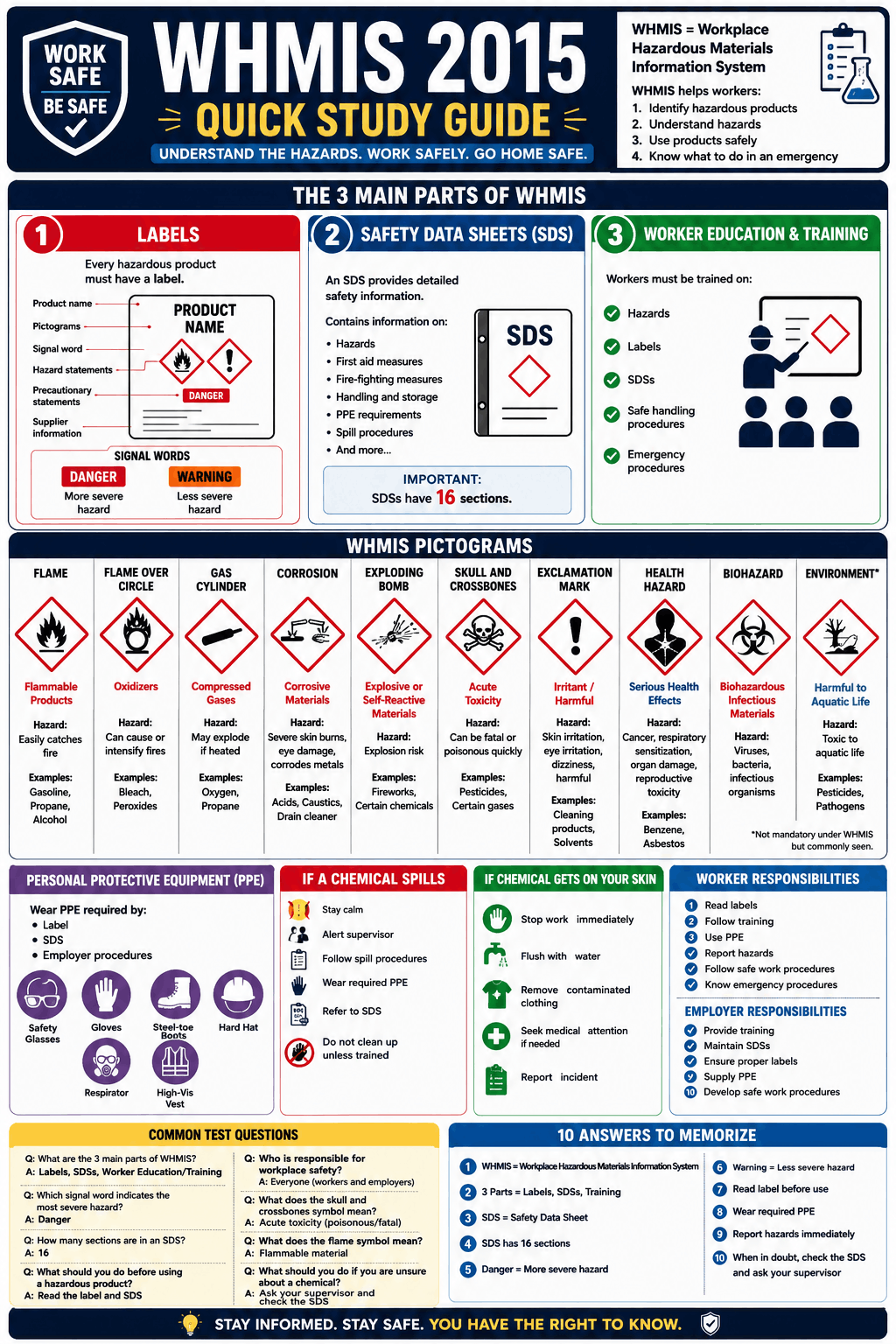
WHMIS Quick Study Sheet
WHMIS stands for Workplace Hazardous Materials Information System. It teaches workers how to safely use, handle, store, and respond to hazardous products at work.
3 Main Parts of WHMIS
1. Labels: Tell you the product name, hazards, precautions, and supplier info.
2. Safety Data Sheets, SDS: Detailed safety information about the product.
3. Worker Education: Training so workers understand hazards and safe procedures.
Supplier Label Must Include
- Product identifier
- Pictogram, if required
- Signal word: Danger or Warning
- Hazard statements
- Precautionary statements
- Supplier identifier
Common WHMIS Pictograms
| Pictogram | Meaning | Example Hazard |
|---|---|---|
| Flame | Flammable | Can catch fire easily |
| Skull and Crossbones | Acute toxicity | Can be poisonous or fatal |
| Corrosion | Corrosive | Can burn skin, eyes, or metals |
| Health Hazard | Long-term health effects | Cancer, breathing problems, organ damage |
| Exclamation Mark | Less serious health hazard | Skin irritation, eye irritation, dizziness |
| Gas Cylinder | Compressed gas | May explode if heated |
| Exploding Bomb | Explosion hazard | Reactive or explosive material |
| Flame Over Circle | Oxidizer | Can make fires worse |
| Environment | Environmental hazard | Dangerous to aquatic life |
| Biohazard | Biohazardous infectious material | May cause disease |
Safety Data Sheet, SDS
An SDS gives detailed information about a hazardous product. Workers should know where SDS documents are kept and how to read them.
Important SDS Sections to Know
- Section 1: Product and supplier information
- Section 2: Hazard identification
- Section 4: First-aid measures
- Section 5: Fire-fighting measures
- Section 6: Accidental release measures
- Section 7: Handling and storage
- Section 8: Exposure controls and PPE
Safe Handling Basics
- Read the label before using any product.
- Check the SDS before handling unfamiliar chemicals.
- Wear proper PPE such as gloves, goggles, masks, or aprons.
- Never mix chemicals unless trained and told to do so.
- Store products in the correct area.
- Report spills, leaks, damaged labels, or missing SDS sheets.
- Wash hands after handling hazardous products.
Quick Test Review
Q: What does WHMIS stand for?
A: Workplace Hazardous Materials Information System.
Q: What does SDS stand for?
A: Safety Data Sheet.
Q: Which signal word is more serious, Danger or Warning?
A: Danger.
Q: What should you do before using a hazardous product?
A: Read the label and check the SDS.
Q: What does PPE stand for?
A: Personal Protective Equipment.
Final Rule
When in doubt, stop and ask a supervisor. Never guess when working with hazardous materials.